
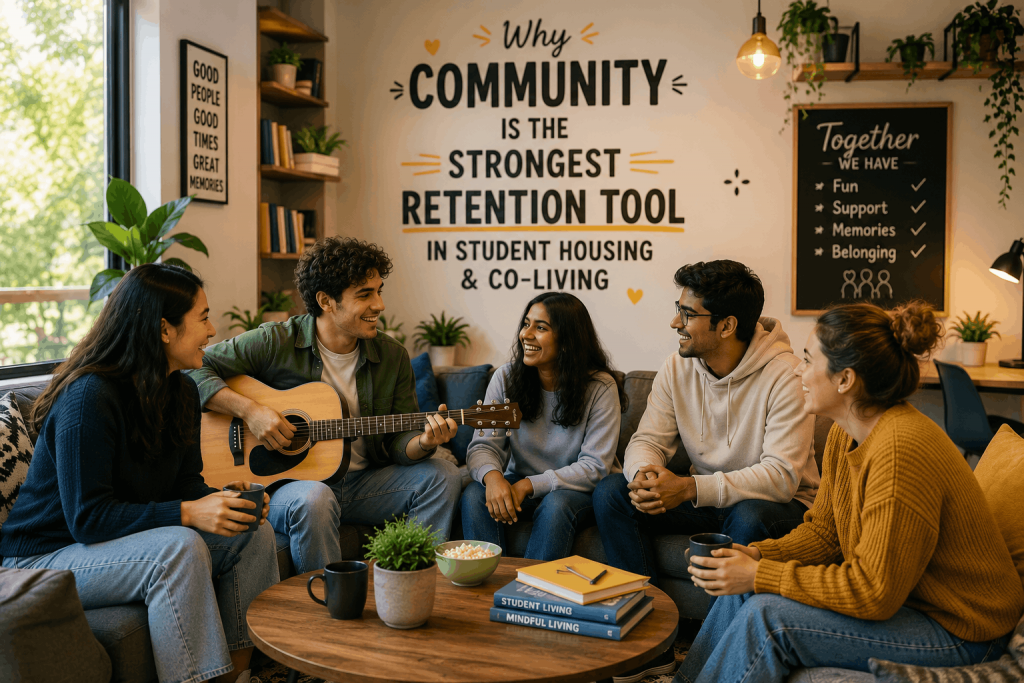
Management leaders across industries agree on one powerful truth: people don’t leave companies, they leave environments where they don’t feel connected. When employees build friendships at work, it acts as a stress buster, improves communication, creates emotional safety (yes, even healthy boss-bashing), and makes people far less likely to quit.
The same principle applies—often more strongly—to student housing and co-living ecosystems.
Community as a Stress Buffer for Students & Young Professionals
Students and early-career professionals living away from home face multiple pressures—academic deadlines, competitive environments, career uncertainty, financial stress, and loneliness in a new city. A strong community within a co-living space helps residents:
- Share academic and work-related stress with peers
- Build friendships that reduce isolation and anxiety
- Get emotional support during exams, job changes, or personal lows
- Feel a sense of belonging rather than “temporary accommodation”
When residents feel emotionally supported, their quality of stay improves dramatically.
Community Drives Long-Term Retention
A well-designed community transforms a property from a place to stay into a place to belong. This directly impacts retention:
- Residents with friends in the same property are less likely to shift
- Peer bonds increase emotional switching costs, not just financial ones
- Familiar faces, routines, and shared memories make moving out harder
- New residents integrate faster when communities are active and inclusive
Simply put, people don’t easily leave people.
Business Impact: Lower Churn, Higher Revenue Stability
Strong communities create tangible business advantages for student housing operators:
- Lower tenant churn, reducing frequent check-outs and re-onboarding
- Reduced marketing and acquisition costs
- More predictable and consistent cash flows
- Fewer operational hassles of room vacancy cycles
- Higher word-of-mouth referrals from happy residents
Retention driven by community is far more sustainable than discounts or short-term incentives.
Beyond Amenities: Designing for Human Connection
While amenities attract bookings, community sustains occupancy. Common kitchens, co-working areas, events, peer learning sessions, festivals, wellness activities, and informal hangout spaces all play a critical role in building human connections.
In student housing and co-living, community is not a soft feature—it’s a strategic asset.
Conclusion
Just as friendships retain employees in organizations, community retains residents in co-living spaces. Operators who invest in emotional well-being, peer connections, and shared experiences don’t just create better living spaces—they build long-term, resilient businesses.